
Vat Savitri is a sacred festival observed by married Hindu women, symbolizing love, loyalty, and the wish for their husband’s long life. On this day, women pray for a strong and everlasting marital bond.
In Hindu tradition, the Vat Savitri Fast is observed during the month of Jyeshtha.
In North India, it is celebrated on Jyeshtha Amavasya (New Moon Day),
While in many other regions, it is observed on Jyeshtha Purnima (Full Moon Day).
Women who observe this fast with full devotion are believed to be blessed with prosperity, marital happiness, and good fortune.
In 2025, the Jyeshtha Purnima Fast falls on 3rd June (Saturday).
Purnima Tithi Begins: 3rd June, Saturday – 11:16 AM
Purnima Tithi Ends: 4th June, Sunday – 09:11 AM
Brahma Muhurta: 03:44 AM – 04:26 AM
Pratah Sandhya Muhurta: 04:05 AM – 05:07 AM
Abhijit Muhurta: 11:29 AM – 12:23 PM
Vijaya Muhurta: 02:12 PM – 03:07 PM
Godhuli Muhurta: 06:44 PM – 07:05 PM
Sayahna Sandhya Kaal: 06:45 PM – 08:42 PM
Amrit Kaal: 07:11 PM – 08:42 PM
Ravi Yoga: 05:07 AM – 06:16 AM
These are the most favorable timings to perform the rituals and seek divine blessings.
The Vat Savitri Fast is a symbol of eternal good fortune and marital devotion.
According to Hindu mythology, Savitri, a devoted wife, brought her husband Satyavan back from the clutches of death through her faith and wisdom.
Since then, women observe this fast to pray for their husband’s long life, family prosperity, and unbroken marital happiness. During the ritual, they worship Satyavan, Savitri, and Lord Yama (the god of death). Married women also adorn themselves with traditional solah shringar (16 adornments) and perform rituals around the Banyan tree (Vat Vriksha).
The Banyan tree holds deep spiritual importance in this festival. It is believed that Savitri revived Satyavan under a Banyan tree, and thus it became sacred.
According to Hindu belief:
Lord Brahma resides at the roots,
Lord Vishnu in the middle, and
Lord Shiva at the top of the Banyan tree.
This makes the tree a symbol of longevity, strength, and good fortune. From a scientific point of view, the Banyan tree also helps purify the air, making it beneficial for health and the environment.
1. Preparation:
Wake up early and take a purifying bath.
Wear clean, traditional clothes (preferably red or yellow).
Gather essential puja items – Kalash, red thread, flowers, fruits, rice grains, vermillion, turmeric, and sweets.
2. Setting Up the Kalash:
Fill the Kalash with water, decorate it with mango leaves, and place a coconut on top.
Keep it at the puja altar or near the Banyan tree.
3. Puja Thali Arrangement:
Arrange all items neatly on a plate.
If possible, include pictures or idols of Savitri, Satyavan, and Lord Yama.
4. Worship at the Banyan Tree:
Visit a Banyan tree and clean the area around it.
Sprinkle water at its roots and offer flowers, turmeric, and vermillion.
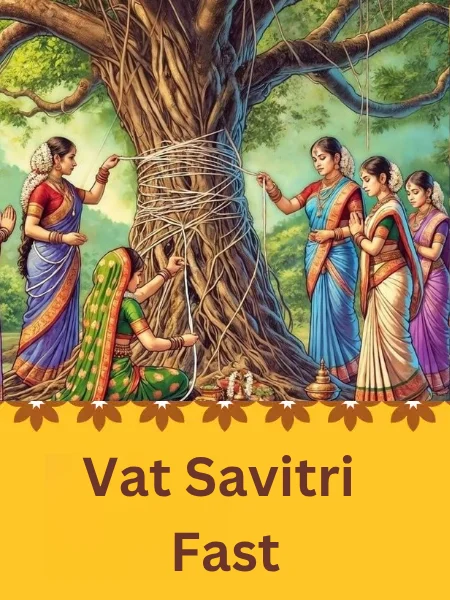
Pour water on the roots and tie a red sacred thread around the trunk while going around the tree three or seven times.
5. Invocation and Prayer:
Light a diya (lamp) and incense sticks.
Chant mantras or prayers dedicated to Savitri and Satyavan.
6. Story Recitation and Aarti:
Listen to or read the story of Savitri and Satyavan.
Perform Aarti and offer sweets as prasad.
Distribute the prasad among family and neighbors.
7. Fasting:
Women observe a fast throughout the day.
Some consume fruits and milk, while others observe a nirjala vrat (without food or water).
The fast is broken after the evening prayers.
8. Closing Prayer:
End the ritual by praying for your husband’s long life, family happiness, and peace.
Princess Savitri, known for her intelligence and virtue, chose Satyavan, a noble but poor prince, as her husband—even after learning that his life would be short. The couple lived happily in the forest, cherishing each other deeply.
One day, as foretold, Satyavan collapsed and died beneath a Banyan tree. Refusing to accept fate, Savitri sat beside his lifeless body and began to pray with unwavering devotion. Soon, Lord Yama, the god of death, appeared to take Satyavan’s soul. Savitri followed him relentlessly, pleading for her husband’s life.
Moved by her devotion, Yama granted her three boons, but cleverly, Savitri used them to bring Satyavan back to life—restoring her husband’s soul and reuniting the couple.
Her courage, wisdom, and faith symbolize the power of true love and dedication. Since then, women observe Vat Savitri Fast to honor her devotion and seek blessings for their husband’s longevity and family prosperity.
Vat Savitri Fast beautifully represents faith, love, and strength. It reminds every married woman of the power of devotion and the sacred bond of marriage. May the blessings of Savitri and Satyavan bring happiness, prosperity, and longevity to every home.